


 EN
EN
 AR
AR
 FR
FR
 DE
DE
 JA
JA
 KO
KO
 PT
PT
 RU
RU
 ES
ES
 DA
DA
 FI
FI
 NO
NO
 SV
SV
 TL
TL
 BG
BG
 HR
HR
 CS
CS
 NL
NL
 EL
EL
 HI
HI
 PL
PL
 RO
RO
 IW
IW
 SR
SR
 SK
SK
 SL
SL
 UK
UK
 VI
VI
 SQ
SQ
 ET
ET
 HU
HU
 MT
MT
 TH
TH
 MS
MS
 GA
GA
 IS
IS
 AZ
AZ
 KA
KA
 BN
BN
 MN
MN
How to Assemble a Trade Show Booth in 20 Minutes?
"I hate almost everything about trade shows, and the booth setup is the absolute worst part."
"I'm spending an average of $25,000 per event (for a 10x10 booth, hotel, and airfare) just to have a presence there. A mediocre booth alone costs $10,000 to $15,000, and even shipping our own materials incurs thousands in union fees just to get them moved."
This isn't just an isolated complaint; it represents the authentic voice of many U.S. exhibitors. In the current trade show landscape, exhibiting has long since ceased to be merely about showcasing products; it has evolved into a strategic battleground defined by cost management, efficiency, and execution prowess.
For exhibition display companies and booth designers, a core truth is becoming increasingly evident: whoever can help clients save both time and money is the one who will win their business.
In today's U.S. trade show environment, exhibiting has transcended the simple act of product display, transforming into a complex game of cost control, operational efficiency, and resource allocation. For small and medium-sized enterprises , the average investment of up to $25,000 per event(covering booth rental, travel expenses, and logistics).Makes every minute of delay and every penny of hidden expenditure feel like a heavy burden.
1. Deconstructing the "Hidden Costs" of U.S. Exhibiting: Why Is the Traditional Model No Longer Sustainable?
Based on in-depth observations of numerous exhibitors, the challenges currently facing trade shows center primarily on uncontrollable costs and convoluted processes. First among these is the relentless rise in baseline expenses; the overall cost threshold for participating in a standard trade show is now fast approaching the $30,000 mark.
Even more vexing for exhibitors are the pervasive union restrictions and logistical cost premiums found in U.S. exhibition halls. Since material handling and booth assembly often mandate the hiring of high-priced union labor, companies find it nearly impossible to avoid incurring thousands of dollars in labor service fees—even when they bring their own equipment. Furthermore, traditional exhibition booths are often bulky and difficult to store; the on-site coordination required during transport, setup, and dismantling is highly prone to delays, resulting in many investments ultimately becoming nothing more than expensive "disposable assets." Against this backdrop, an urgent demand has emerged in the market: Is there a solution that allows independent SMEs to achieve professional-grade, high-end visual presentations without the need for external outsourcing or the hiring of additional labor?
Based on extensive discussions with numerous exhibitors, current trade shows face four primary challenges:
① Rising Exhibition Costs
For a standard 10×10 ft booth, the total cost typically includes:
• Basic Booth Fee: $10,000–$15,000
• Total Exhibition Expenses: $20,000–$25,000+
For small and medium-sized enterprises (SMEs), this represents a significant financial investment.
② Union Restrictions and Hidden Fees
In many U.S. exhibition venues:
• Material handling (drayage) must be performed by union labor.
• Booth installation incurs additional labor charges.
Even if you bring your own booth structure, it is impossible to completely avoid these costs.
③ Complex and Time-Consuming Setup
Common issues with traditional exhibition booths include:
• Difficulties in on-site communication.
• Installation delays.
• Numerous unpredictable variables.
The associated time costs are often severely underestimated.
④ Shipping and Storage Burdens
Traditional booths often present the following challenges:
• Bulky dimensions and high shipping costs.
• Difficulties regarding storage.
• They often sit idle after being used just once.
Consequently, many exhibition booths end up becoming "one-time investments."
For many U.S. exhibitors, particularly SMEs participating in trade shows independently, a recurring question arises: "Is there a way to set up a professional-looking booth without wasting time, money, and energy?"
No one wants to incur hefty expenses covering booth fees, hotel stays, transportation, and more. only to arrive at the venue and attempt to attract customers using a booth that looks completely cheap and unprofessional. Conversely, if one were to disregard budget constraints and simply opt for a high-end, custom-built booth requiring six months of booking with a contractor and the payment of exorbitant construction and shipping fees, such an undertaking would be an incredibly difficult, if not impossible, feat for most SMEs.
A startup brand preparing for a regional fair in California faced a familiar set of challenges:
① A limited exhibition team (just two people)
② No prior experience in booth construction
③ A tight budget
④ No time to coordinate with professional booth builders
As is often discussed among entrepreneurs online, their primary concern was simple:
“We don’t want to spend thousands of dollars building a booth for an event that lasts only two days.”
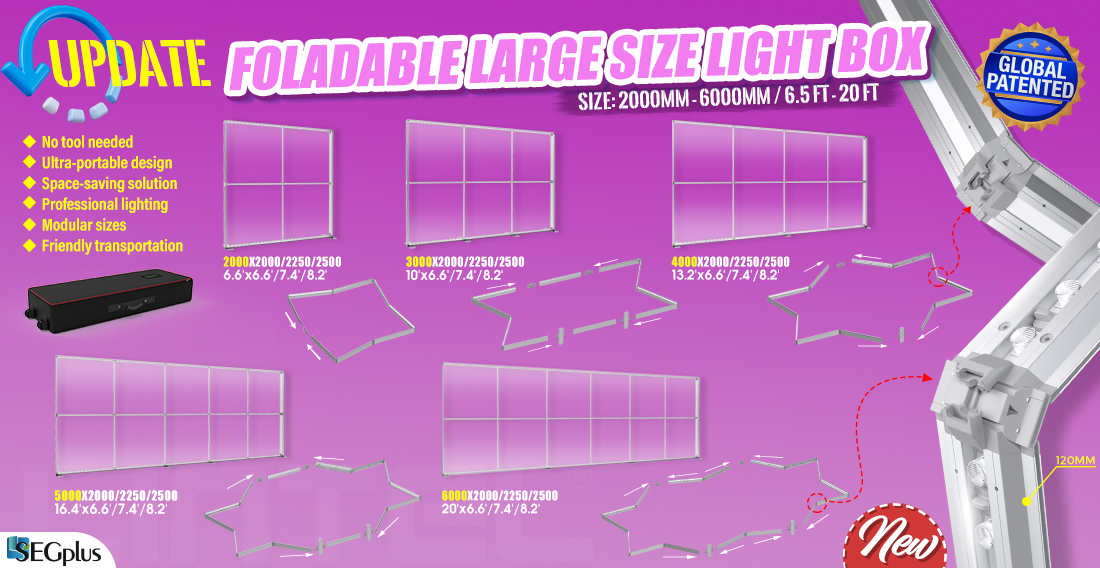
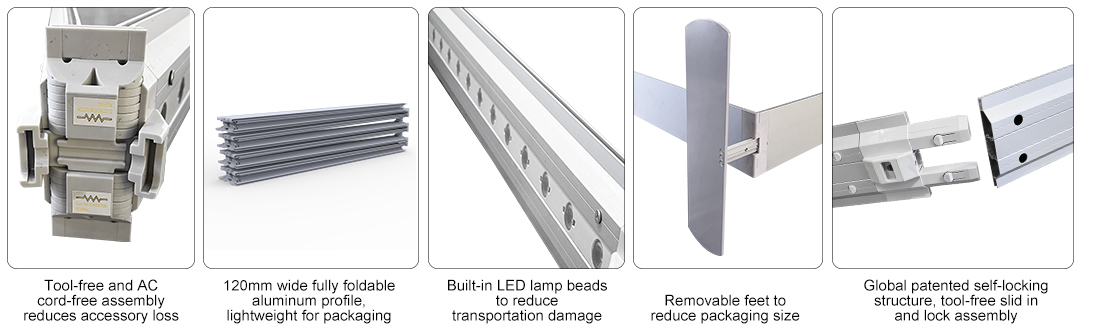
Addressing these specific pain points, Lintel introduced its 120mm SEG collapsible pop-up lightbox system—a solution that is quickly becoming a favorite in the U.S. market. This system represents not merely a product upgrade, but a complete redefinition of the exhibition experience.
√ Minimalist Setup, Avoiding Union Surcharges: The core highlights of this system are its "all-in-one collapsible structure" and its "Slide-in and Lock" tool-free pin design. Even a two person team with absolutely no prior construction experience can fully assemble a 10x10ft backlit booth in under 20 minutes. This highly autonomous design directly enables companies to bypass the exorbitant labor fees often mandated by exhibition venues.
√ Optimized Logistics: The "Trunk-Friendly" Exhibition: Unlike traditional booths that require expensive freight trucking, an entire 10x10ft lightbox booth kit can be easily packed into just two 0.11m³ Oxford trolley bags. Its compact dimensions meet standard shipping requirements, allowing for transport via commercial airline baggage or simply in the trunk of a car, thereby slashing logistics costs, which typically run into the thousands of dollars, to an absolute minimum.
√ Premium Visuals & Sustainable Investment: Utilizing LED SEG (Silicone Edge Graphics) light box frames, the system delivers bright, uniform backlighting that ensures maximum visual impact. More importantly, the robust aluminum alloy frame is built to last; companies need only swap out the graphic prints for different events, enabling a "buy once, reuse indefinitely" approach that significantly reduces the average amortized cost of exhibiting over the long term.
2. Why is this solution particularly well-suited for U.S. exhibitors?
This 120mm SEG Lightbox Booth System was designed specifically to meet the demands of modern trade shows within the U.S. market:
① Bypass Union Labor Costs:
Many exhibition venues in the U.S. mandate the hiring of paid union labor for booth installation.
However, with this tool-free, pop-up lightbox booth system, you can handle the entire assembly process yourself. A complete 10x10ft backlit booth—including the lightbox wall and counter—can be fully set up in just 20 minutes, potentially saving you thousands of dollars in booth installation labor fees.
② Reduce Overall Exhibition Costs:
Many small exhibitors lack the necessary storage and transportation capabilities. Consequently, arranging for booth dismantling, shipping, and storage becomes a cumbersome process involving significant additional expenses. As a result, most exhibitors end up treating their booths as disposable, requiring them to purchase a brand-new setup for every subsequent trade show. By utilizing the Lintel 120mm folding pop-up lightbox system, however, two people can easily assemble and dismantle the unit without any tools—allowing a single system to be reused across multiple trade shows.
③ Portable and Lightweight: Hassle-Free Travel
The entire portable booth system packs neatly into a dedicated wheeled trolley case. It is suitable for shipping via courier services, sea freight, checked airline baggage, or private vehicle transport. Compliant with standard shipping dimension requirements, its lightweight and compact design ensures you avoid incurring costly "oversized cargo" surcharges.
④ Rapid Setup, Complete Control:
The Lintel 120mm folding pop-up lightbox features an integrated, collapsible structure. Thanks to its tool-free pin-and-lock mechanism, you can simply "slide in and lock" the components to piece the frame together—much like building with blocks.
⑤ Visually Stunning Display Impact:
The LED SEG lightbox provides bright, uniform backlighting for large-format graphics, vividly highlighting your brand's unique characteristics. You can easily swap out the SEG fabric graphics to align with specific events or campaigns, ensuring your booth instantly stands out and captures the attention of every passerby.
3. Why is the Lintel 120mm folding pop-up lightbox so popular among trade show booth builders?
① For booth builders, "time is money." If they can assemble a complete trade show booth using less time and fewer personnel, it presents a viable strategy for rapidly increasing their profit margins.
② To save on air freight costs, many small-scale exhibitors prefer to contract local booth builders at the exhibition venue to construct their stands. Consequently, to meet the needs of these smaller exhibitors, builders must offer booth solutions that are affordable, lightweight, and easy to assemble.
③ The Lintel 120mm folding pop-up lightbox features a compact footprint. For booth builders, utilizing this product for construction allows for effortless transportation, thereby reducing shipping costs while simultaneously enabling them to expand their market service area.
Addressing the common complaints from entrepreneurs who often describe booth construction as a "nightmare" and dread the high labor costs, shipping fees, and complex procedures involved, the Lintel 120mm folding pop-up lightbox booth offers the perfect, ultimate solution. It not only thoroughly resolves user pain points such as the exorbitant fees charged by union labor and the associated time delays through its "tool-free, 20-minute quick assembly" design, but also leverages an ultra-lightweight nylon trolley bag design to slash logistics costs. What once required thousands of dollars in shipping fees can now be transported with the simple ease of fitting into a car trunk. This truly empowers startup brands, even those with limited budgets and lean teams, to possess a professional, backlit trade show booth with immense visual impact. It transforms trade show participation from a stressful, financially draining ordeal into an efficient, autonomous, and reusable journey of brand value enhancement.
FAQ:
1. How long does it take to assemble a trade show booth?
Assembling a traditional trade show booth typically requires 4 to 8 hours—or even longer.
In contrast, utilizing the 120mm foldable SEG lightbox booth allows for complete assembly in just about 20 minutes.
2. Can I assemble a trade show booth by myself?
Yes, you can.
Thanks to its modular, tool-free design, this portable trade show booth can be fully assembled by just two people working independently, requiring no professional construction experience or additional hired labor.
3. How can I reduce trade show booth costs in the USA?
Key ways to reduce costs include:
① Using reusable modular light box booths
② Avoiding union labor fees
③ Choosing portable structures to minimize shipping costs
4. What is an SEG light box booth?
An SEG light box booth is a backlit display system that utilizes Silicone Edge Graphics. It features:
① Bright, uniform illumination
② Quick and easy graphic replacement
③ A professional visual aesthetic
5. Is a portable trade show booth worth it?
For small and medium-sized enterprises (SMEs), it is highly worthwhile:
① It lowers long-term exhibition costs
② It improves setup efficiency
③ It reduces reliance on external vendors
6. How do you transport a light box booth?
Foldable light box booths can be packed into wheeled transport cases:
① Suitable for air freight shipping
② Fits easily into a car trunk
③ Compliant with standard shipping dimensions
7. What booth sizes can be built using foldable light boxes?
Common configurations allow for the construction of:
① 10×10 ft (approx. 9 m²)
② 10×20 ft (approx. 18 m²)
or even larger modular booth combinations.